
On the beautiful afternoon of 2nd of March, Mr Torgeir Aleti began our first Digital Marketing tutorial. We discussed the workings of Digital Marketing, to help us understand what basis the subject is taught on and its different components. The slideshow was constructed by Mr. Aleti’s past learnings and what he has thought to be of relevance. As all of the students in the tutorial were beginners in the subject he especially captured our attentions through his engaging discussion and friendly conversation with us.
Mr. Aleti gives us references drawing on how digital marketing progressed from an industrial era to modern society.
He compares the history of digital marketing highlighting
the “post-industrial economy” to its involvement of how it is changing today’s
diversification of marketing components, showing critical evaluation and
understanding of the continuing dynamics of progression in a marketing sense. Contrasting
these two theories puts digital marketing into perspective of how it has
evolved and how it is now relevant to be used as a tactic
in a marketing
I decided to research how many organisations have integrated digital marketing it into their marketing strategy or use it as a separate action and it shows 34% of respondents to have integrated it, with nearly 50% not having a defined strategy for it. I believe the 34% shows ‘younger’ companies knowing the importance of digital marketing and the impact it has on consumers, while the 50% and 17% are still coming to realise the need for this component in their practices. This shows the emergence of companies of realising the importance of digital marketing into their overall marketing strategies
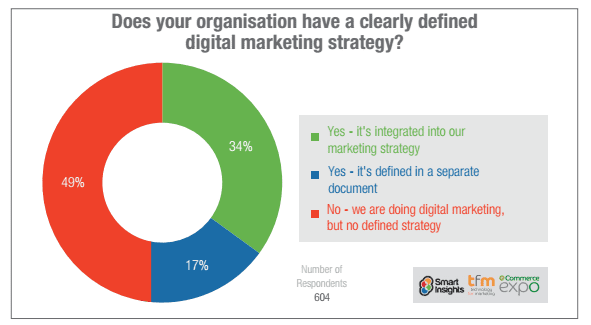 |
| Does your organisation have a clearly defined digital marketing strategy?, 2018, Smart Insight |
Looking back on to the presentation, it shows me that dramatical
changes in history such as the “post-industrial economy” can change society
drastically where new markets and improved production can be formed, quoting
Mr. Aleti “the world is changing very rapidly”.
Feel free to leave a comment on my insights and show me what you know and how I can improve. :)
Feel free to leave a comment on my insights and show me what you know and how I can improve. :)
Comments
Post a Comment